
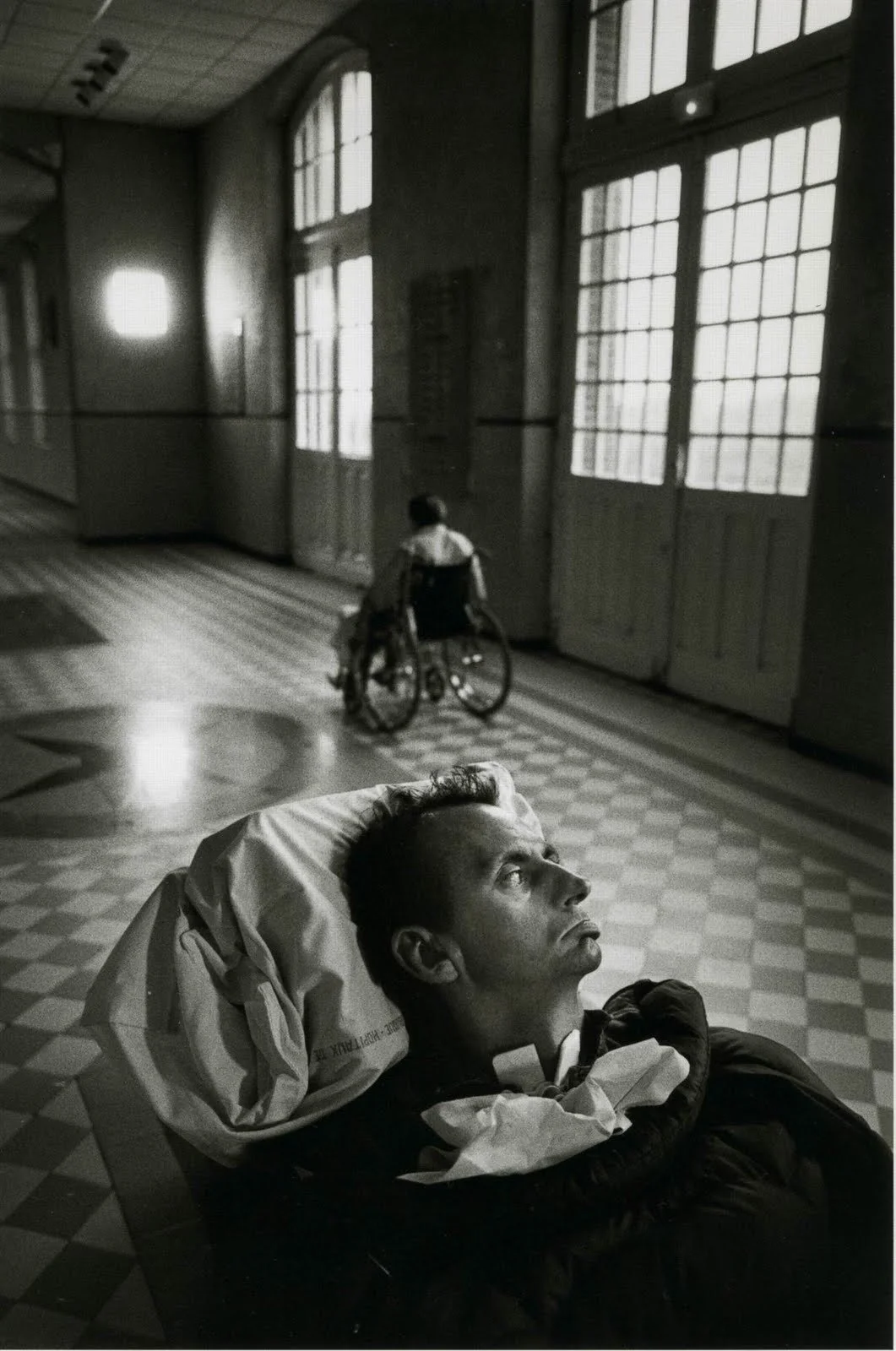
During the hours when nobody was there to take dictation, he composed in the dark. The book was being written twice, once in his mind, in the silence, and once in blinks, letter by letter, in a hospital room in France. He had standards. He had a voice. The book that emerged was not a document of suffering but a piece of literature, wry, precise, shot through with a dark and specific humour that no amount of physical catastrophe had managed to extinguish. He called it Le Scaphandre et le Papillon. The Diving Bell and the Butterfly. The bell was the body. The butterfly was everything else.
He did this for ten months. He died two days after it was published.
The butterfly, in Bauby's formulation, was the free thing. The mind, the imagination, the interior life that the diving bell could not contain. The butterfly was what remained when everything else had been taken, the part that could still move, still reach, still make something worth making.
The locked in era has inverted this entirely.
The body is free. Fully functional, carefully maintained, optimised and tracked and fuelled with precision. The body has never been more attended to, more monitored, more deliberately managed than it is right now by the generation that uses this phrase. And the mind, the butterfly, has been turned inward. Not by illness. Not by a stroke in a car on the way to pick up a son. By choice. The mind contracted to the dimensions of a wellness protocol, the attention directed exclusively toward the self, the outward reach replaced by the inward monitoring of a life being optimised rather than lived.
Bauby used his one free part to reach toward other people. To make something that would exist beyond him, that would be read by people he would never meet, that would mean something to someone in a hospital room or on a train or at three in the morning when they needed it. The butterfly went outward.
The memories worth having are not made inward. They are made with other people, in the unglamorous and unoptimised texture of a life that is actually being lived rather than being prepared for. You cannot make a memory alone in a clean flat with your macros tracked and your phone face down and your morning protocol running on schedule. The memories require presence, not the performed presence of someone who has decided to be intentional today, but the actual presence of a person who has shown up somewhere, with other people, and let something happen that couldn't have been planned for.
Bauby had one eyelid and used it to reach outward. The locked in era has everything and is using it to look inward.
To Be “Locked In”
You know the one. The person who has decided, with complete sincerity, that this is the period. The phone is down. The diet is clean. The sleep is tracked. The mornings start at five and the first hour belongs to the body. Movement, hydration, the careful ingestion of things that have been added to the protocol. No social obligations that might compromise ‘The Programme’. No distractions. No noise. Just the self, turned entirely toward the self, optimised and focused and completely, deliberately, proudly ‘locked in’.
It is not a stupid thing. It is not a malicious thing. It is a reasonable response to a world that pulls attention in every direction simultaneously and offers very little in return. The locked in era is an attempt at control, at presence, at the feeling of moving through a day with intention rather than being moved through it by other people's priorities. There is something genuinely admirable in the commitment.
On the 8th of December 1995, Jean-Dominique Bauby was driving to pick up his son when a massive stroke stopped everything. He was 43. He was the editor-in-chief of French Elle. He was fully inhabited in his life. Successful, present, moving through the world with the ordinary momentum of a person who has not yet been given a reason to consider how contingent all of it is.
He fell into a coma for twenty days. When he came out of it, he discovered what locked in actually means.
The clinical term is locked-in syndrome. The word locked does not quite cover it. Bauby's mind was entirely present. Fully operational, completely intact, capable of thought and memory and feeling and humour and literary ambition and the full range of everything that had made him who he was. His interior life had not been touched. What had stopped was everything else. Every voluntary muscle in his body had ceased to respond to instructions. The brain was sending signals.
Nothing was receiving them.
He had one exception. His left eyelid.
This is worth sitting with. The entirety of Jean-Dominique Bauby, his personality, his intelligence, his memories of his children, his preferences, his grievances, his opinions about lunch, his capacity for irony and beauty and genuine literary thought, had a single exit point. One eyelid. Blinking.
The method they developed was this: an assistant would read through the French alphabet in frequency order. E, S, A, R, I, N, T, U, L, the most common letters first. Bauby would blink when she reached the right one. One blink. The letter was recorded. She started again. A word might take two minutes. A sentence might take twenty. A paragraph required holding the entire architecture of the thought in his head, revising it, refining it, maintaining it, across hours of blinking, while his body lay motionless and his one working part opened and closed against the light.